
10 Fifth-Wheel Interiors That Feel Like a Small House

On this page13 sections
- Start with what makes it feel like a camper
- Add lamps that plug in
- Replace the valances with curtains
- Lay a rug that defines the living room
- Swap the theater seats for a real sofa
- Turn the booth dinette into a table and chairs
- Make the bedroom feel like a bedroom
- Hang art with travel-safe hardware
- Change the cabinet hardware
- Hide the road gear
- Bring in plants, real or not
- Keep weight in mind
- Common questions
A fifth-wheel has something most campers do not: proportions that start to resemble a real home. The raised front bedroom gives you a separate sleeping area up a few steps, the rear or mid living room often has a true sofa, and the ceilings tend to be taller than in a travel trailer. With a few changes, the space stops feeling like a vehicle with furniture bolted in and starts feeling like a small house that happens to have wheels.
The trick is not decorating more. It is replacing the parts that announce “RV” with things you would find in a house: a lamp instead of only overhead LEDs, curtains instead of pleated shades, a rug that defines a sitting area, a dining table you can actually sit around. These ten ideas work for full-timers and weekend owners alike, and nearly all of them can be undone before you sell.
As an Amazon Associate I earn from qualifying purchases.
Start with what makes it feel like a camper
Walk in and notice what your eye lands on first. In most fifth-wheels it is the same handful of things: rows of identical flush ceiling lights, a valance and pleated day-night shades on every window, a carpet runner that stops abruptly at the slide-outs, a booth dinette with tall vinyl backs, and a theater seating unit that faces a television on the kitchen island. None of these are bad, but together they are the signature of a factory interior. Change three or four of them and the whole rig reads differently.
Make a list, then rank the changes by effort. Lighting and textiles are fast and fully reversible. Furniture swaps take more planning because of weight and how pieces are secured. Paint and paper sit in between.
It helps to set a simple palette before buying anything. Pick one main neutral for the large surfaces, one or two accent colors for pillows and throws, and one wood or metal finish for hardware and lamps. A narrow palette makes a small interior look calm and planned, and it stops impulse purchases that clutter the space.
1. Add lamps that plug in
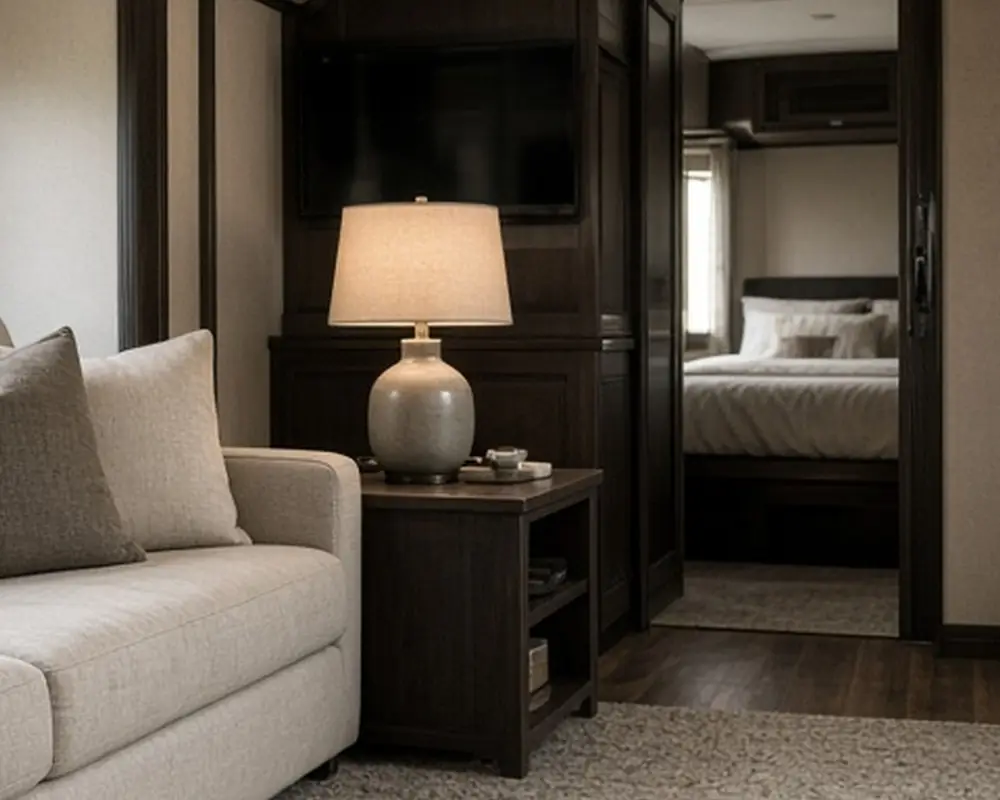
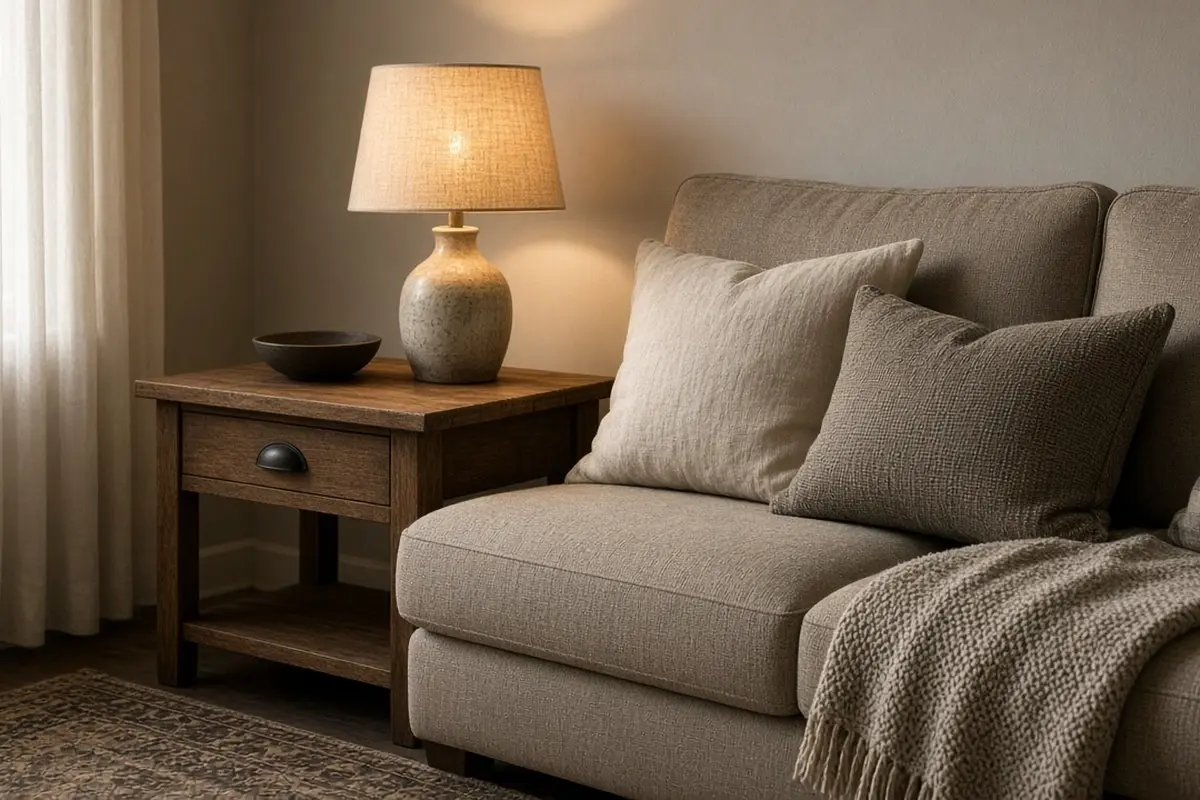
Overhead lights flatten a room. A house relies on layers of light at different heights, and a fifth-wheel can too. A small table lamp on an end table, a plug-in wall sconce beside the sofa, and a little lamp on the bedroom nightstand change the mood of the evening completely. Choose lamps with wide, heavy bases or secure them with museum putty for travel days, and store shades in a drawer when you are moving.
Warm bulbs matter as much as the lamp itself. Look for bulbs around 2700K, which match the glow of a house in the evening, and swap any very cool white overhead LEDs for warmer ones while you are at it. Many owners also add dimmers to the factory ceiling lights, which makes the overheads usable at night instead of harsh.
Get the look
2. Replace the valances with curtains
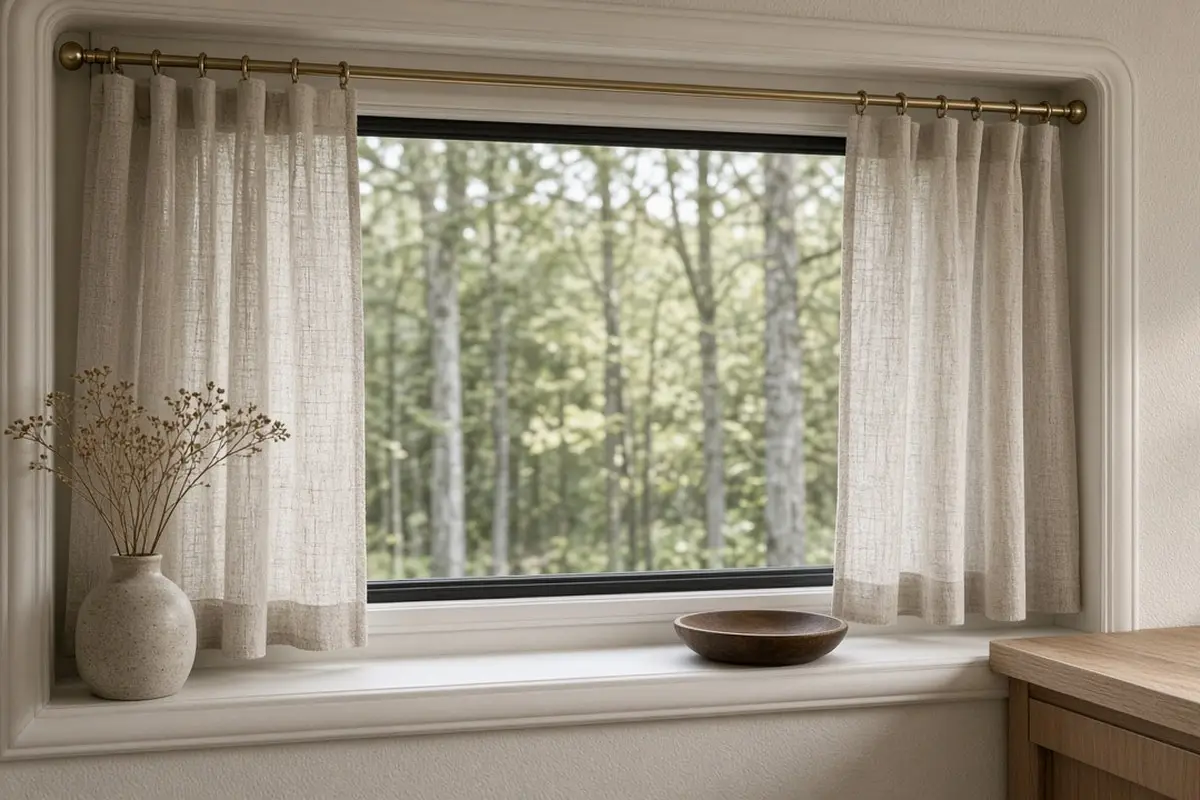
Hard valances and pleated shades are the most “RV” detail of all. Removing the valance and hanging simple linen curtains on a slim rod makes a window look like it belongs in a cottage. Keep the shades behind for privacy and light control, or replace them with roller shades. Tension rods or small screw-mounted brackets work well, and many owners mount the rod a few inches above the window frame to make it look taller.
Get the look
3. Lay a rug that defines the living room
A house has rooms; a fifth-wheel has one long space with zones. A rug anchors the seating area and tells your eye where the living room starts and stops. Choose a low-pile or flatweave rug that will not catch on the slide-out mechanism, and put a thin non-slip pad underneath.
Size the rug generously. In a house, a rug that is too small makes furniture look like it is floating, and the same is true in a rig. Ideally the front legs of the sofa sit on the rug. If the slide-out has a step, choose a rug that fits on the slide floor itself rather than draping over the edge. Washable rugs earn their keep in a rig where dirt comes in every time the door opens.
4. Swap the theater seats for a real sofa
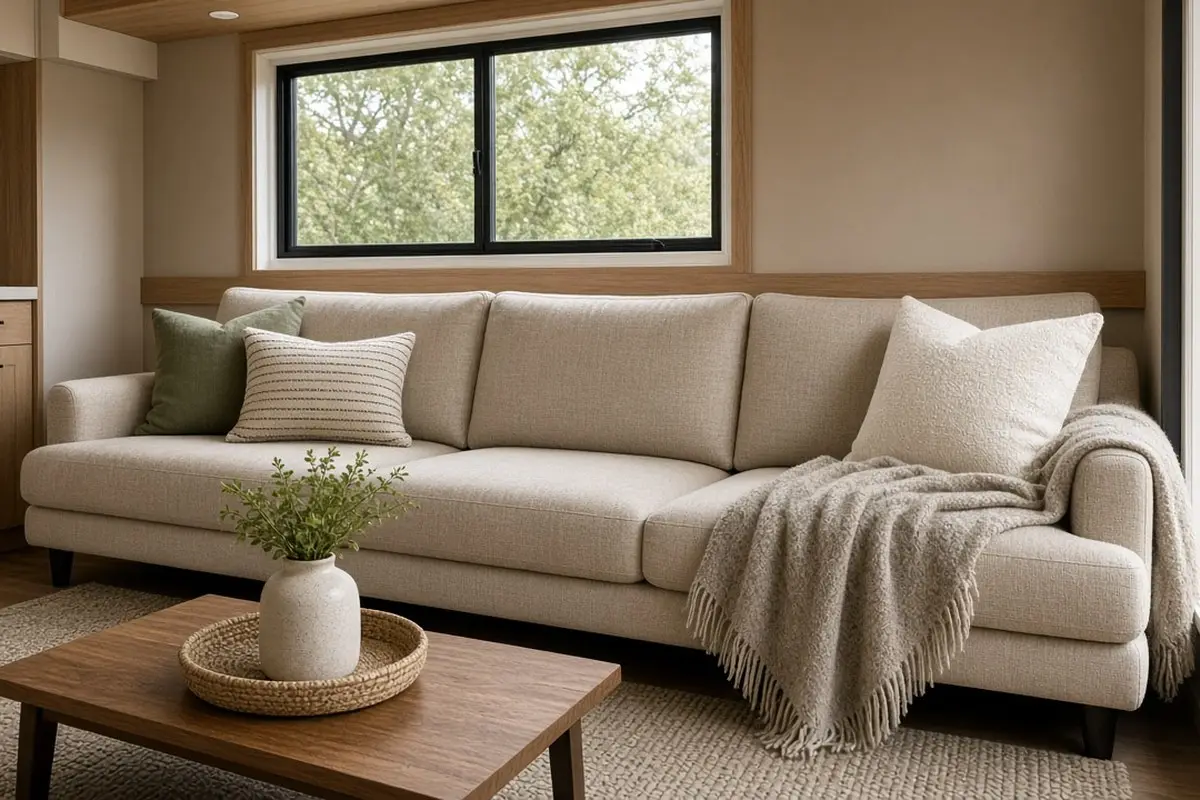
Many owners remove the reclining theater seats or the factory jackknife sofa and put in a small apartment-scale sofa. It is the biggest single change you can make toward a house feel. Check the weight against your cargo capacity, measure the door and the turn into the rig, and plan how you will secure the new piece, usually with brackets bolted to the floor or the wall. A sofa around seventy inches wide fits most slide-outs.
Get the look
5. Turn the booth dinette into a table and chairs
A booth with tall upholstered backs eats visual space. Replacing it with a small round or rectangular table and two or four chairs makes the area feel like a breakfast nook in a house. Folding or stacking chairs can be stowed for travel, and a drop-leaf table gives you room for guests without blocking the aisle every day.
Padded seat cushions tied to the chairs make them comfortable for longer meals, and a simple linen runner or placemats turn the table into something you look forward to using rather than a spot to dump mail and keys.
6. Make the bedroom feel like a bedroom
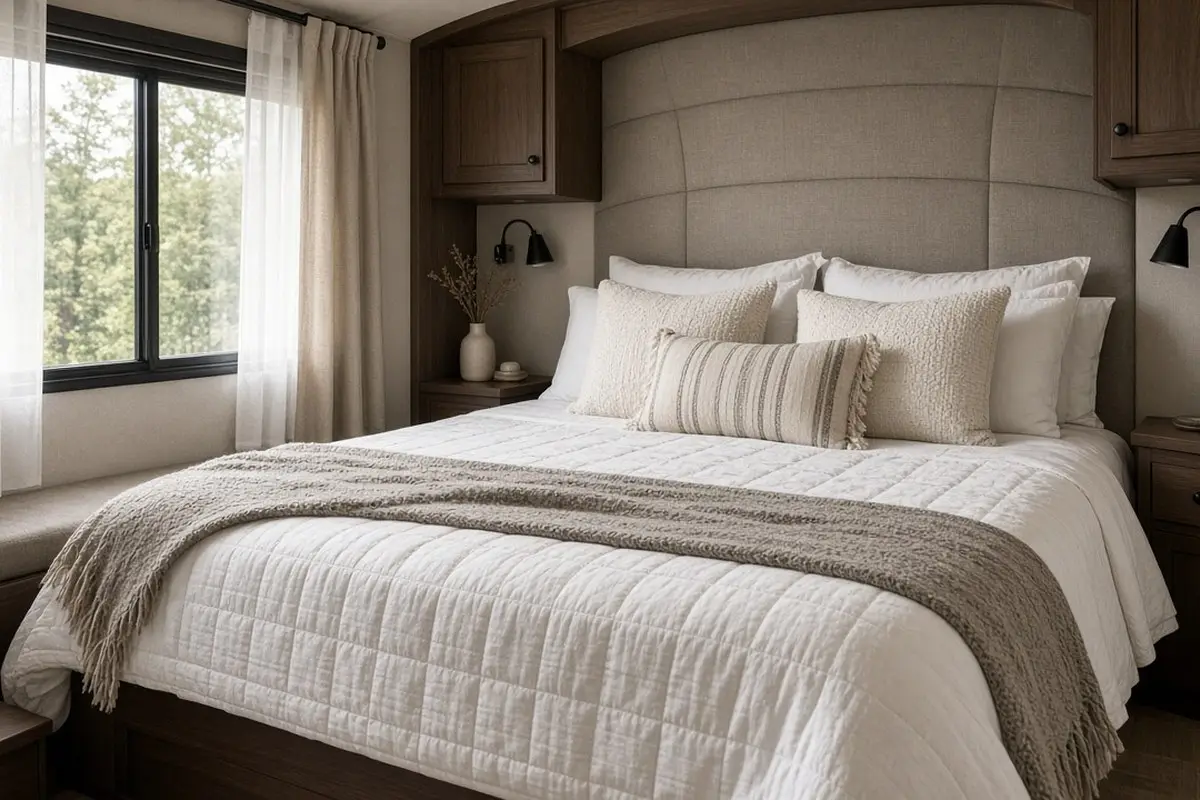
The front bedroom is the space that most resembles a room in a house, so treat it like one. Use real bedding: a duvet, a quilt folded at the foot, and two sizes of pillows rather than a bedspread. Add a headboard panel or a padded headboard if the factory one is plain. A small reading lamp on each side and a basket for the extra throw finish it. If the walls are plain vinyl, a removable paper behind the bed helps a lot; our guide to removable RV wallpaper covers what holds up on the road.
Get the look
7. Hang art with travel-safe hardware
Bare walls are a giveaway that a space is temporary. Small framed prints, a woven wall hanging, or a single larger piece above the sofa make the rig feel lived in. Use acrylic glazing instead of glass, and hang frames with dual-lock fasteners or removable strips at all four corners so they do not swing on rough roads.
Group small pieces tightly rather than spreading them out; on short RV walls, a tight cluster looks deliberate. A mirror is also worth considering, as it bounces light from the windows and makes the living area look deeper.
8. Change the cabinet hardware
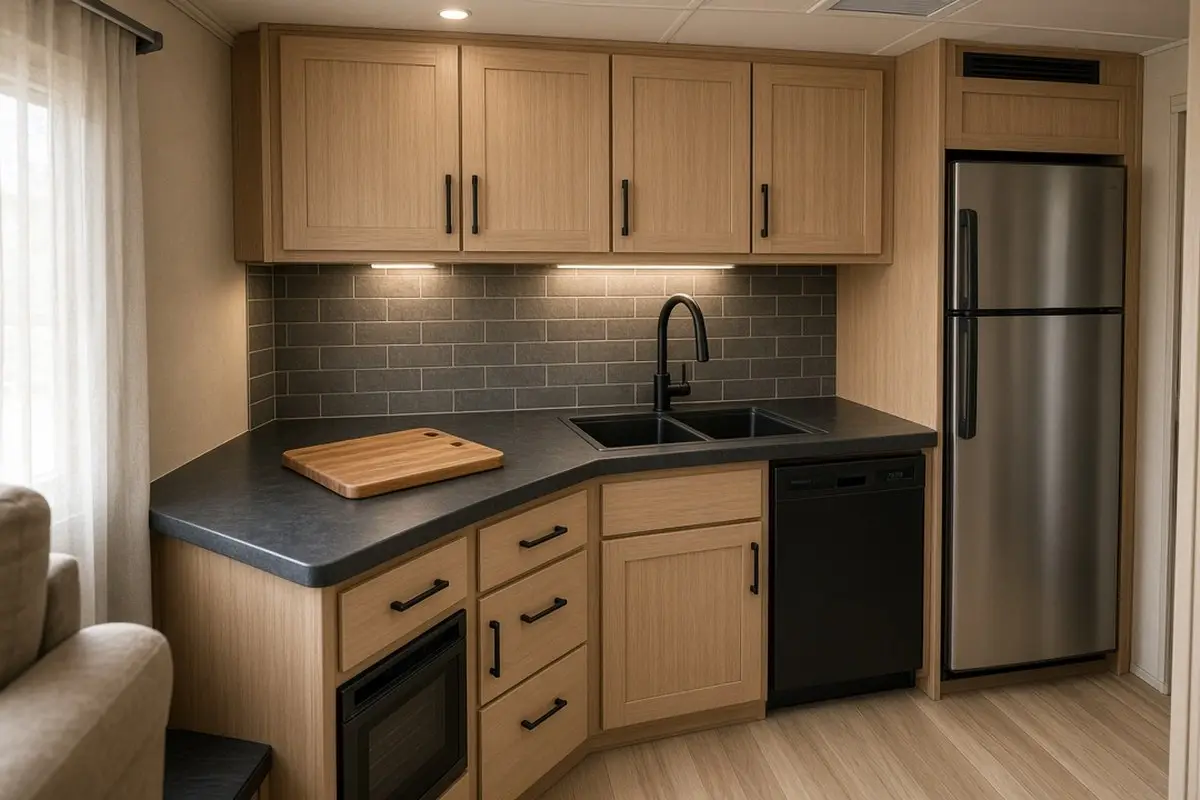
Factory cabinet pulls are often shiny and generic. Swapping them for simple matte black, brass, or leather pulls makes the kitchen look like a small house kitchen. Most pulls attach with one or two screws, so the job takes an afternoon. Keep the original hardware in a labeled bag if you plan to sell.
While the doors are open, consider replacing the factory faucet with a simple house-style one in a matching finish. It is one of the few plumbing swaps most owners can manage, and it finishes the kitchen. For working out the counter side of the galley, see our camper kitchen prep space ideas.
Get the look
9. Hide the road gear
Nothing breaks the house illusion like hoses, levelers, wheel chocks, and a surge protector tumbling out of a cabinet. Give road gear its own home in the basement storage, in labeled bins, so the interior holds only what you would keep in a house. Inside, use lidded baskets and closed boxes rather than open bins of cords and chargers.
A charging drawer is one of the best upgrades for a lived-in feel. Run a power strip into a drawer near an outlet so phones and tablets charge out of sight. The counters stay clear, and the room looks like a home rather than an office.
10. Bring in plants, real or not
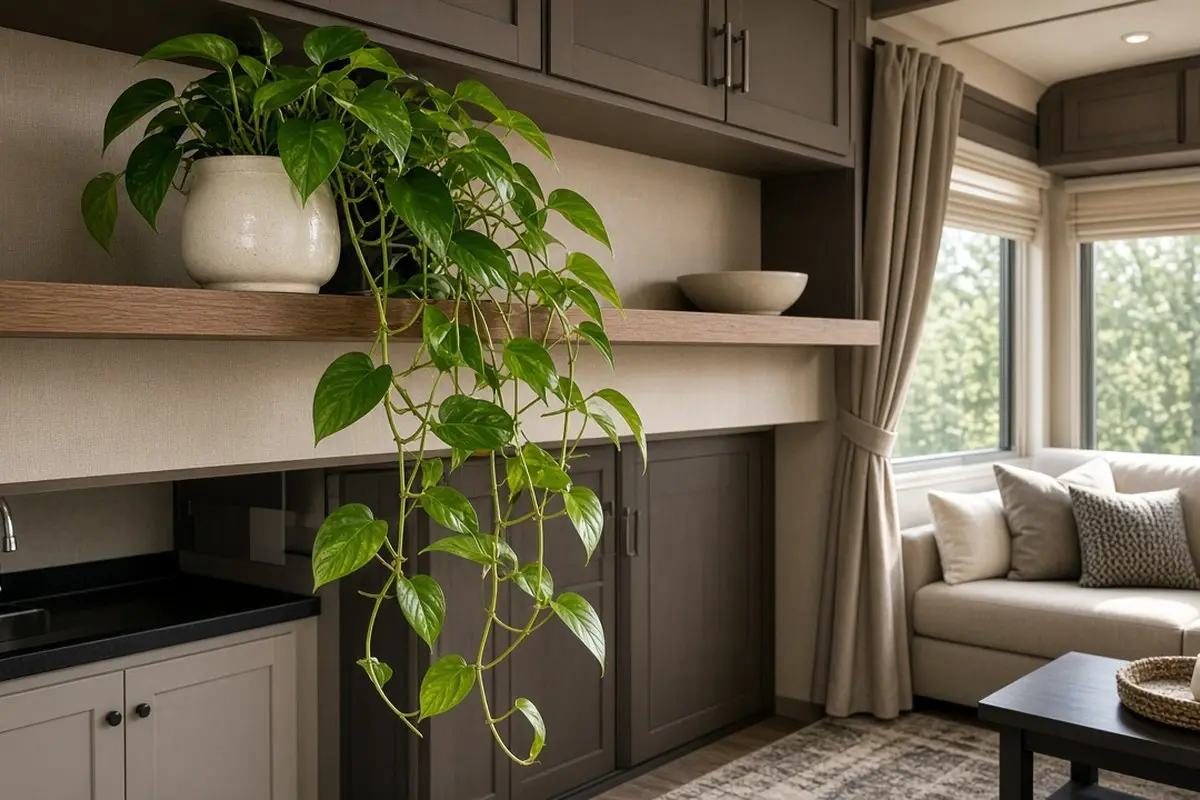
A plant on the table or a small trailing pothos on a high shelf is one of the strongest signals of a lived-in home. Real plants travel surprisingly well if you secure them in a sink or a bin on travel days.
Good choices for a rig include pothos, snake plants, ZZ plants, and small hoyas, all of which tolerate uneven light and the occasional missed watering. Group two or three together in matching pots for a stronger effect than a single plant on its own. If upkeep is not realistic, a good faux plant in a heavy pot still softens the corners.
Get the look
Keep weight in mind
Every change adds weight, and fifth-wheels have a cargo carrying capacity that is easy to exceed. Weigh what you remove and what you add. Swapping a heavy theater unit for a lighter sofa can save weight; adding a solid-wood dining set might not. Visit a public scale before and after a big change and keep the numbers.
Weight distribution matters too. Heavy items belong low and close to the axles, not in the front overhead cabinets or at the very rear. Spreading the load keeps the rig stable on the road.
Common questions
Can you put regular furniture in a fifth-wheel? Yes, as long as it fits through the door, stays within your weight limits, and is secured for travel.
What makes an RV feel like a house? Layered lighting, curtains, rugs, real bedding, and art do most of the work.
Is it worth renovating a fifth-wheel? If you use it often or live in it, small reversible changes add a great deal of comfort for modest effort. Major structural changes are harder to justify and can affect resale.
For small-scale furniture planning that translates well to a rig, see our small living room furniture plans.