
9 Entry Mirrors and the Height They Should Hang

On this page12 sections
- The basic rule
- A round mirror above a console
- A rectangular mirror over a bench
- A full-length leaner by the door
- A pair of slim mirrors either side of a door
- An arched mirror in a narrow hallway entry
- A mirror with hooks or a shelf
- A mirror opposite the front door
- A cluster of small mirrors
- A mirror above a radiator or shoe cabinet
- Hanging a mirror safely
- Common questions
An entry mirror has two jobs. It should make the space feel brighter and larger, and it should let you check your face, your collar, or the spinach in your teeth before you walk out the door. Hang it too high and only the tallest person in the house sees anything but their forehead. Hang it too low and it reflects the top of the console and a pile of mail. Height is where most entry mirrors go wrong.
Below are nine common entry mirror setups, each with a practical hanging height, plus the general rules for sizing a mirror to the wall and the furniture beneath it.
As an Amazon Associate I earn from qualifying purchases.
The basic rule
For a mirror you look into while standing, the center should sit roughly at average eye level, around fifty-seven to sixty-five inches from the floor. If the people in your house are mostly tall, go higher; if you have kids who want to check their hair, a bit lower is kinder. Above furniture, the bottom edge of the mirror usually sits six to ten inches above the surface, which often lands the center close to that same eye-level range.
Width matters as much as height. Above a console or bench, a mirror around two-thirds to three-quarters the width of the furniture looks balanced. Much narrower and it looks lost; wider and it overwhelms the piece below.
The frame changes how big a mirror feels. A thick wooden or ornate frame adds visual weight, so a framed mirror can be a little smaller than a frameless one and still hold the wall. Thin metal frames in brass or black almost disappear, which suits modern entries and very tight spaces. Consider what the mirror will reflect, too. Stand where the mirror will go and look at the opposite wall. If it shows a window, a piece of art, or a plant, you are in luck. If it shows a coat closet or a jumble of shoes, try shifting it along the wall a foot or two, because the reflection effectively becomes a second piece of decor.
A quick test saves holes in the wall. Cut a piece of cardboard or kraft paper to the size of the mirror, tape it up at the height you plan, and ask everyone in the house to stand in front of it. If the shortest adult can see their full face and the tallest can see theirs without stooping, you have the right height.
1. A round mirror above a console
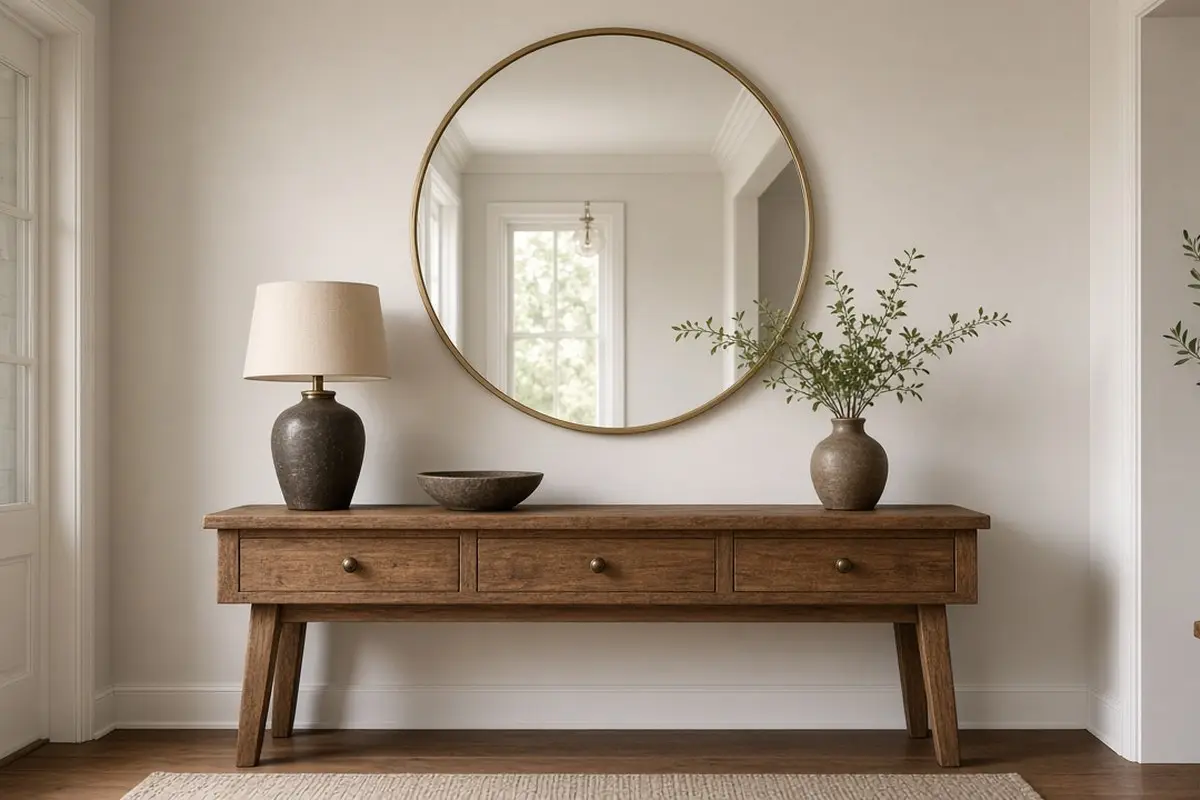
A round mirror softens the straight lines of a console and the doorway beside it. Hang it so the bottom edge sits six to eight inches above the tabletop, and center it on the console rather than the wall. A twenty-four to thirty-inch round suits most consoles around three to four feet wide. If you put a lamp on the console, let the mirror overlap the top of the shade slightly so the two read as one arrangement.
The lamp and mirror pairing is worth getting right because it is the first thing you see in many entries. Place the lamp on one side of the console and a taller object, like a vase of branches, on the other, so the mirror sits between them like a centerpiece. The mirror then reflects the warm glow of the lamp in the evening, doubling the light in the entry. If the console is very narrow, use a small lamp with a slim base so it does not crowd the reflection.
Get the look
2. A rectangular mirror over a bench
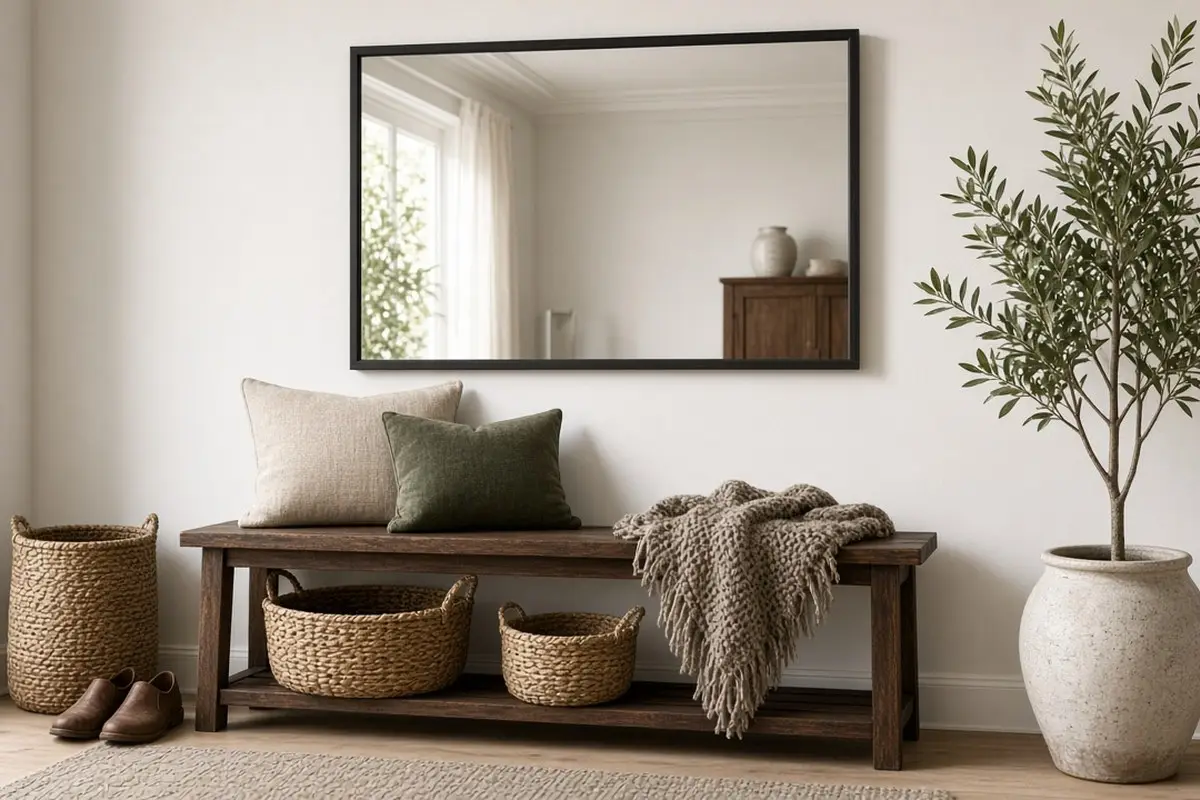
Above a bench, people are sitting as well as standing, so you can hang the mirror a little lower than above a table. Keep the bottom edge about ten to twelve inches above the bench seat so heads do not bump it and coats hanging on hooks nearby do not cover it.
If the bench sits beneath a row of hooks, the mirror can hang in the middle of the hooks or above them. Above works better in busy households, since coats will not hide it, but keep the center no higher than about sixty-six inches so shorter family members can still see. For a bench in a mudroom-style entry, a mirror with a sturdy, wipeable frame copes better with wet umbrellas and bumping backpacks than a delicate gilded one. A horizontal rectangle works well over a long bench; a vertical one suits a short bench in a tight corner.
Get the look
3. A full-length leaner by the door
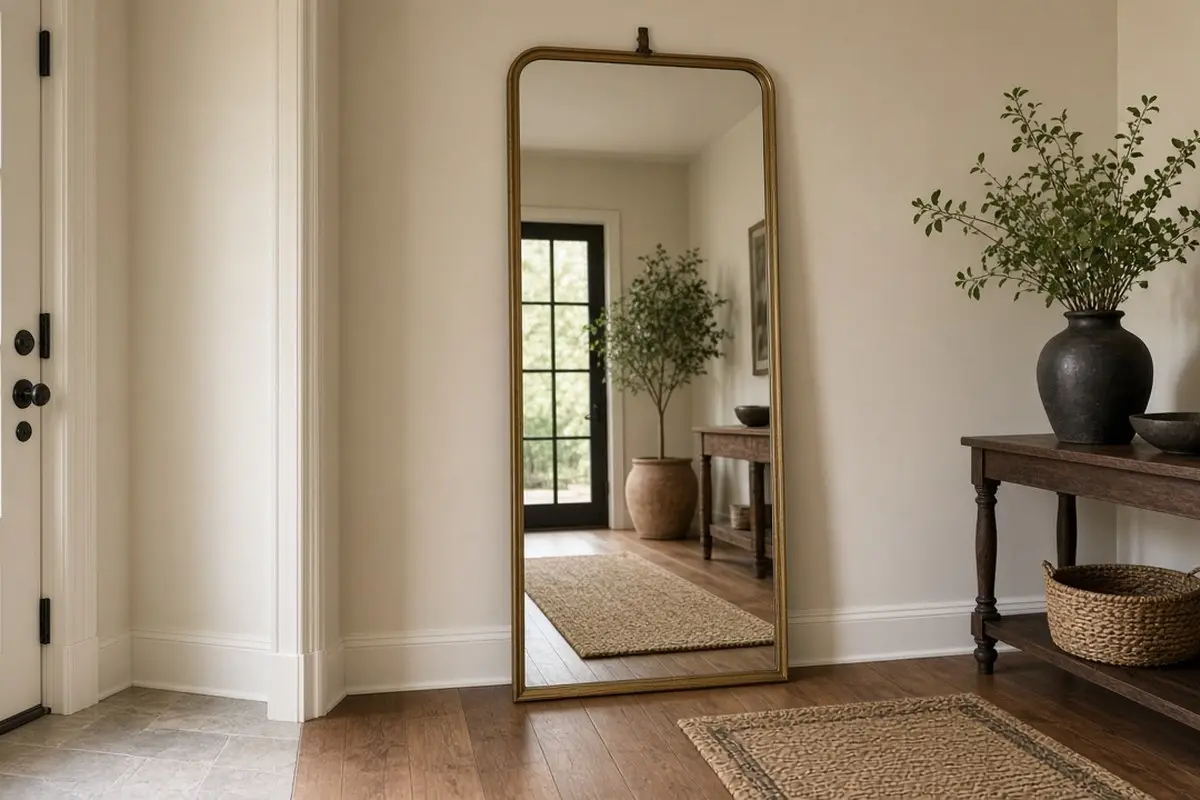
For an outfit check, nothing beats a full-length mirror. A leaner propped against the wall near the door takes no installation, though you should still secure it with a small wall anchor at the top so it cannot slide. Choose one at least five feet tall. In a narrow entry, place it on the wall opposite a window or along the wall you walk toward, so it reflects light rather than a closet door.
If there is truly no wall space, a full-length mirror can hang on the back of the coat closet door or on the inside of the front door itself. Over-door mirrors need no drilling at all. A mirror on the side of a tall cabinet also works. The point is to have one place where you can see your whole outfit before leaving, which saves the trip back to the bedroom.
Get the look
4. A pair of slim mirrors either side of a door
When the entry wall is broken up by a doorway, two tall narrow mirrors on either side make a symmetrical frame. Hang them so the tops align with the top of the door casing or slightly above. This setup bounces light around a dark entry and gives everyone a glance at themselves without needing a big blank wall.
Symmetry suits traditional entries, but this idea also works in modern spaces with simple frameless mirrors or thin black frames. Keep the two mirrors identical in size and frame, and measure carefully so they sit the same distance from the door casing. A pair of sconces above them adds even more light in the evening and turns an awkward doorway wall into the most finished part of the entry.
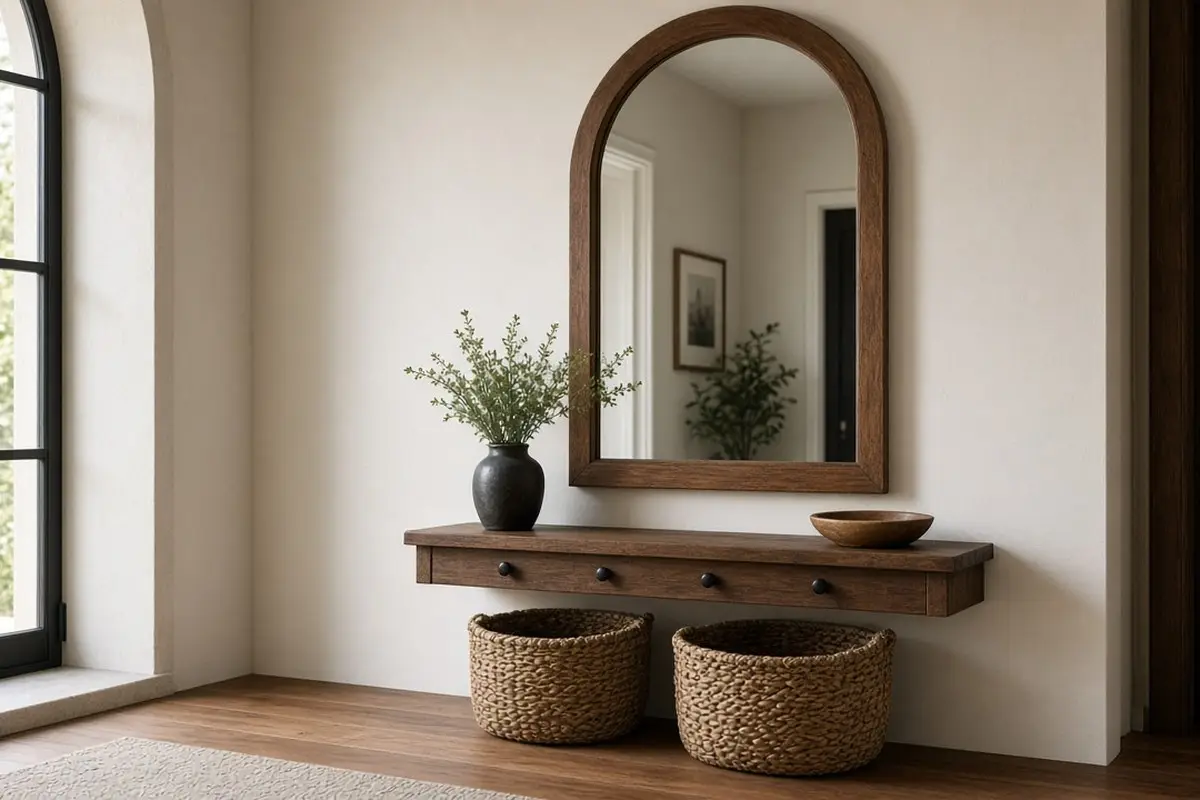
5. An arched mirror in a narrow hallway entry
An arched mirror adds height and a little architecture to a plain hallway entry. Hang it vertically, with the center at about sixty inches, or let it sit taller above a narrow shelf. The arch draws the eye upward, which helps low-ceilinged entries feel taller.
Get the look
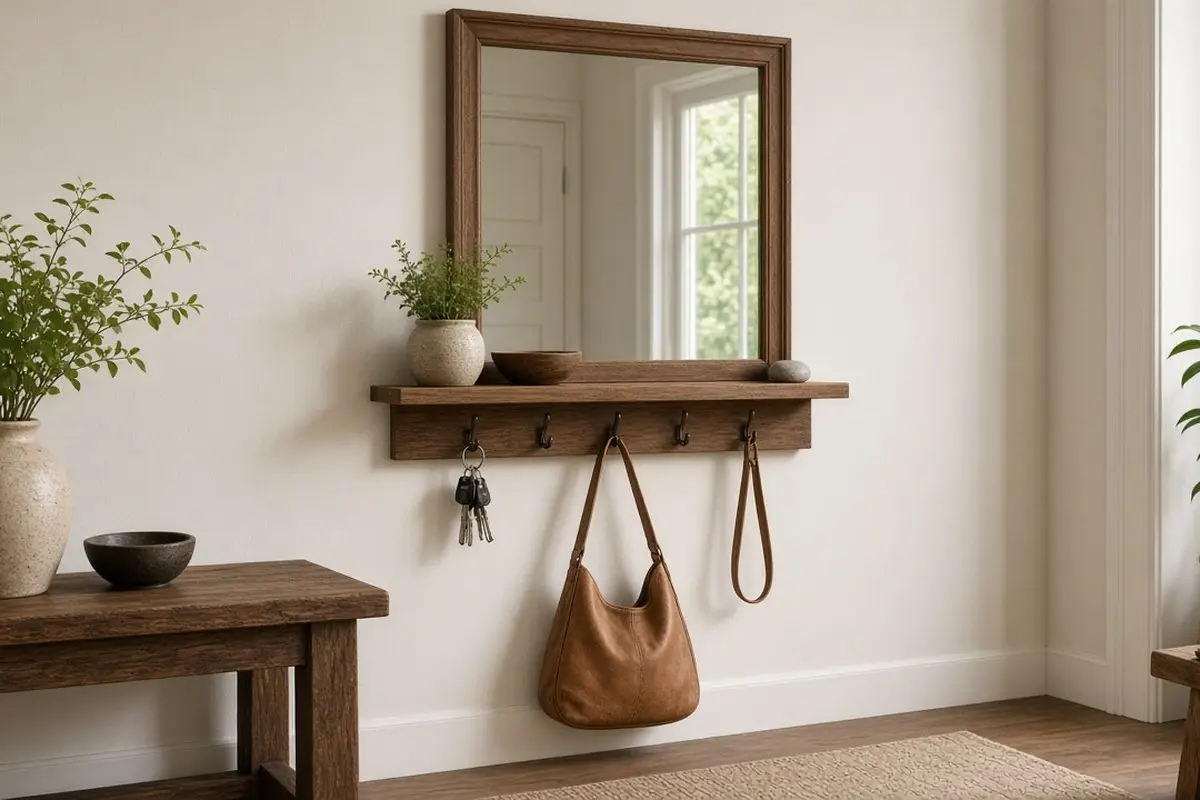
6. A mirror with hooks or a shelf
A mirror with a built-in ledge or hooks is a small-entry multitasker. Hang it so the hooks sit around fifty-four to sixty inches from the floor, comfortable for reaching up to grab a bag, which puts the mirror itself at eye level. The ledge holds keys and sunglasses, which keeps the console clear or replaces it entirely.
Get the look
7. A mirror opposite the front door
Hanging a mirror directly opposite the front door is popular for bouncing light and making a small entry feel deeper. Hang it at standard eye height, and make sure it reflects something pleasant when the door is open, like a view of the garden, rather than the neighbor’s garage.
In a very small entry, a mirror opposite the door can make the space feel twice as deep, which is a big help when the door opens almost straight into a wall. Choose a mirror nearly as wide as the doorway so the reflection reads as an extension of the room rather than a small window. A simple frame keeps attention on what the mirror reflects. Some people avoid this spot for personal reasons; if so, the side wall works just as well for light.
8. A cluster of small mirrors
A group of small mirrors in different shapes can work as wall decor, catching light from several angles. Treat it like a gallery: lay the arrangement out on the floor first, keep the outer edges roughly rectangular, and center the whole cluster at eye level. Include at least one mirror large enough to check your face so the group is practical as well as pretty.
Gold, brass, and black frames can mix happily in a cluster as long as one finish dominates. Space the mirrors two to three inches apart, about the same gaps you would use for a gallery wall, and use small felt pads on the back corners so they hang flat and do not mark the paint.
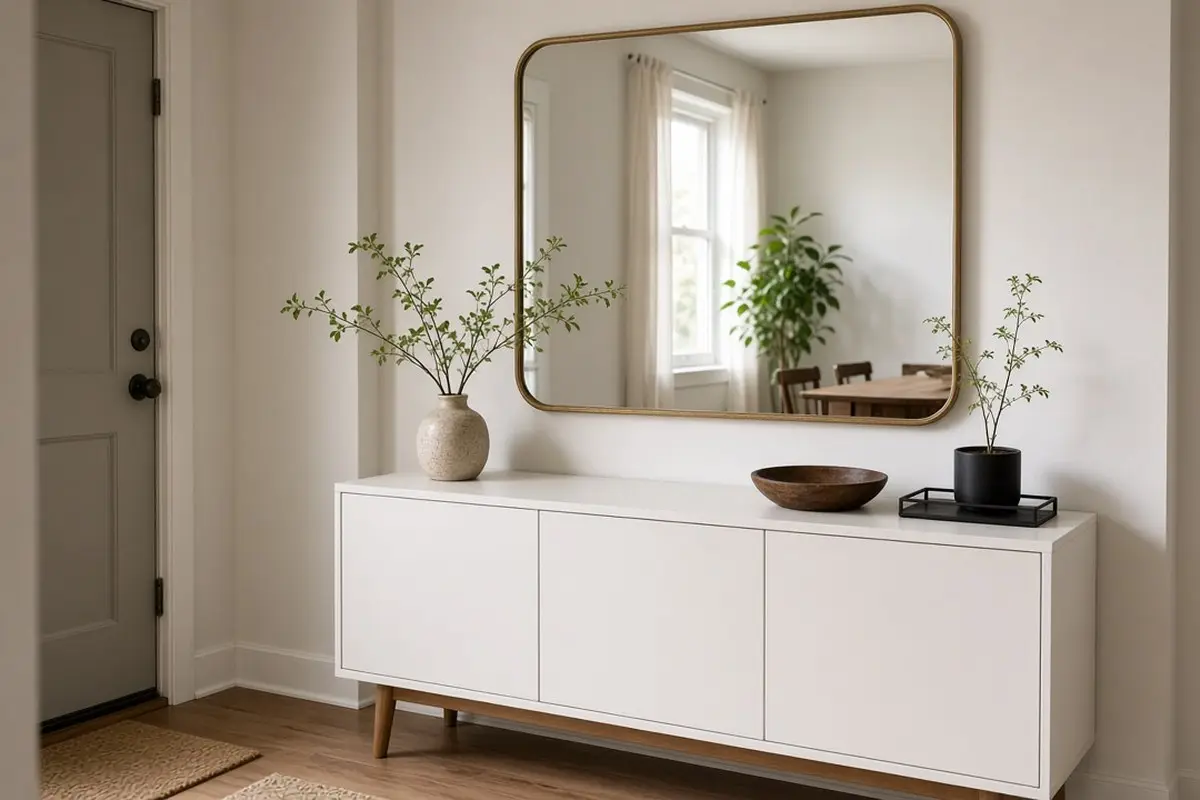
9. A mirror above a radiator or shoe cabinet
Many entries have a radiator or low shoe cabinet on the only free wall. Hang a mirror above it with the bottom edge eight to twelve inches above the top, leaving room for heat to rise and for the cabinet lid to open. A slim frame suits this spot because the furniture below is usually bulky.
Get the look
Hanging a mirror safely
Mirrors are heavy for their size. Use the hanging hardware rated for the weight, find a stud where you can, and use heavy-duty anchors where you cannot. Two hooks spaced apart keep a mirror level better than a single nail. For leaners, a furniture strap or small bracket at the top stops the mirror sliding or tipping.
Common questions
How high should an entryway mirror hang? Center it around fifty-seven to sixty-five inches from the floor, or six to ten inches above the console or bench beneath it.
What size mirror goes above a console? Roughly two-thirds to three-quarters the width of the console.
Should an entry mirror be round or rectangular? Round mirrors soften a boxy entry and suit consoles; rectangles work over benches and in tight spots where you want a taller reflection.
For more ways to use mirrors, see mirror placements for light and our guide to narrow entry tables.