
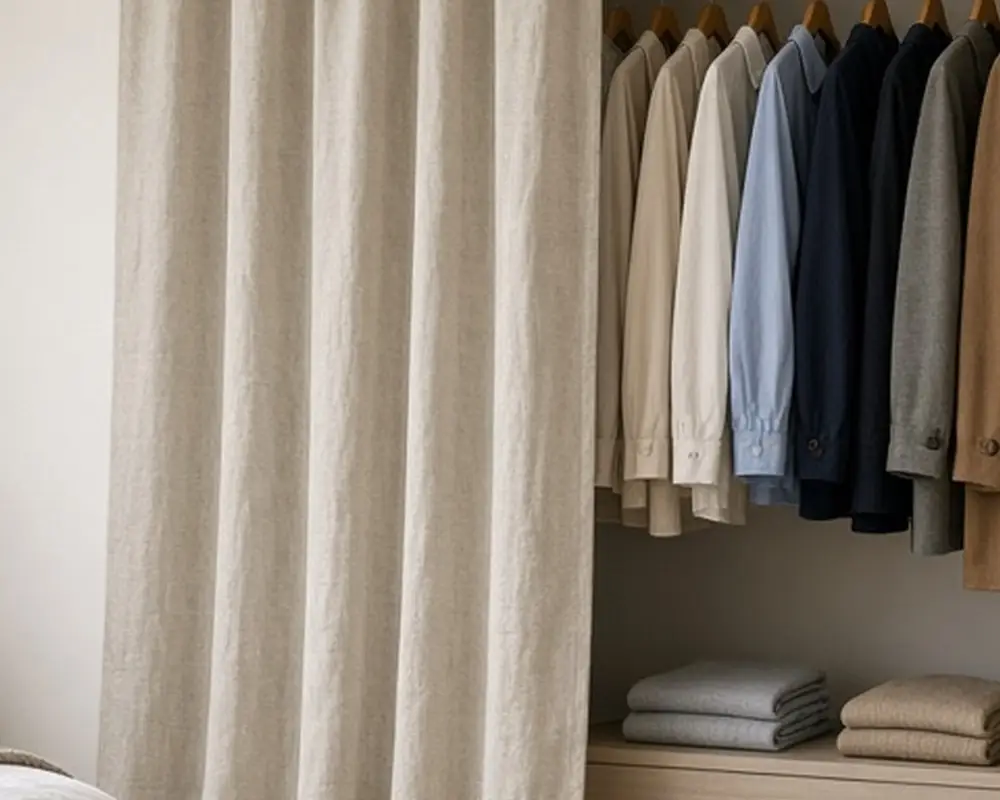
7 Closet Curtains That Replace a Door

On this page12 sections
- Measure for a curtain that looks right
- A ceiling-mounted track
- Natural linen panels
- A tension rod for renters
- Patterned fabric as a feature
- Matching the window curtains
- A blackout lining for kids’ rooms
- A curtain for an open alcove## A note on bifold tracks
- A curtain for an open alcove
- Hardware details
- When a door is still better
- Common questions
Bifold doors jump their tracks, sliding doors only ever show half the closet, and hinged doors need floor space a small bedroom rarely has. A curtain fixes all three problems. It opens the full width of the closet in one sweep, takes up no swing room, softens a hard wall, and costs far less than a new door. Done well, it looks like a deliberate design choice rather than a stopgap.
Curtains also change the feel of a bedroom in a way doors cannot. Fabric absorbs sound, so the room is a little quieter. It adds texture and softness to a wall that was all hard edges and hardware. And it is easy to change: new curtains in a different color or pattern can refresh the whole room in an afternoon, with no painting or carpentry involved.
These seven approaches cover hardware, fabric, and a few styling decisions, from a renter-friendly tension rod to a ceiling track that makes the whole wall feel taller.
As an Amazon Associate I earn from qualifying purchases.
Measure for a curtain that looks right
Measure the width of the closet opening and add at least six inches on each side so the curtain can stack back clear of the opening. For fullness, choose total fabric width of one and a half to two times the rod length. For height, measure from where the rod or track will sit to the floor and subtract about half an inch so the hem just skims the floor without dragging.
If you remove the old door, patch the hinge holes or track screws and repaint the frame first. A fresh, crisp frame makes the curtain look finished.
Think about how the curtain will stack when open. Each panel bunches into a stack about a quarter to a third of its flat width, so a wide curtain needs room either side, or you lose part of the opening. If the wall beside the closet is short, use one panel that pulls to the side with more space. Consider also whether the curtain needs to close tightly. For a guest room or a bedroom you share, a slight overlap in the middle, or a single wide panel, hides everything behind it.
Take the closet contents into account. A curtain does not hide clutter as firmly as a door, since it moves and occasionally gets left half open. Organize the closet first, so that when the curtain is drawn back, what you see looks tidy rather than chaotic.
1. A ceiling-mounted track
Mounting a curtain track on the ceiling, rather than on the door frame, gives the cleanest look. The curtain falls from ceiling to floor, hides the top of the frame, and makes the wall feel taller. Ceiling tracks glide smoothly and can run wall to wall.
Wall-to-wall curtains work especially well in small bedrooms, where they turn an entire wall into soft fabric and hide not just the closet but any awkward architecture beside it, such as a radiator, a jog in the wall, or a cluster of outlets. The room reads as calmer and more finished. Check the ceiling material before installing, and use anchors suited to plaster or drywall, or screw into joists where possible.

Get the look
2. Natural linen panels
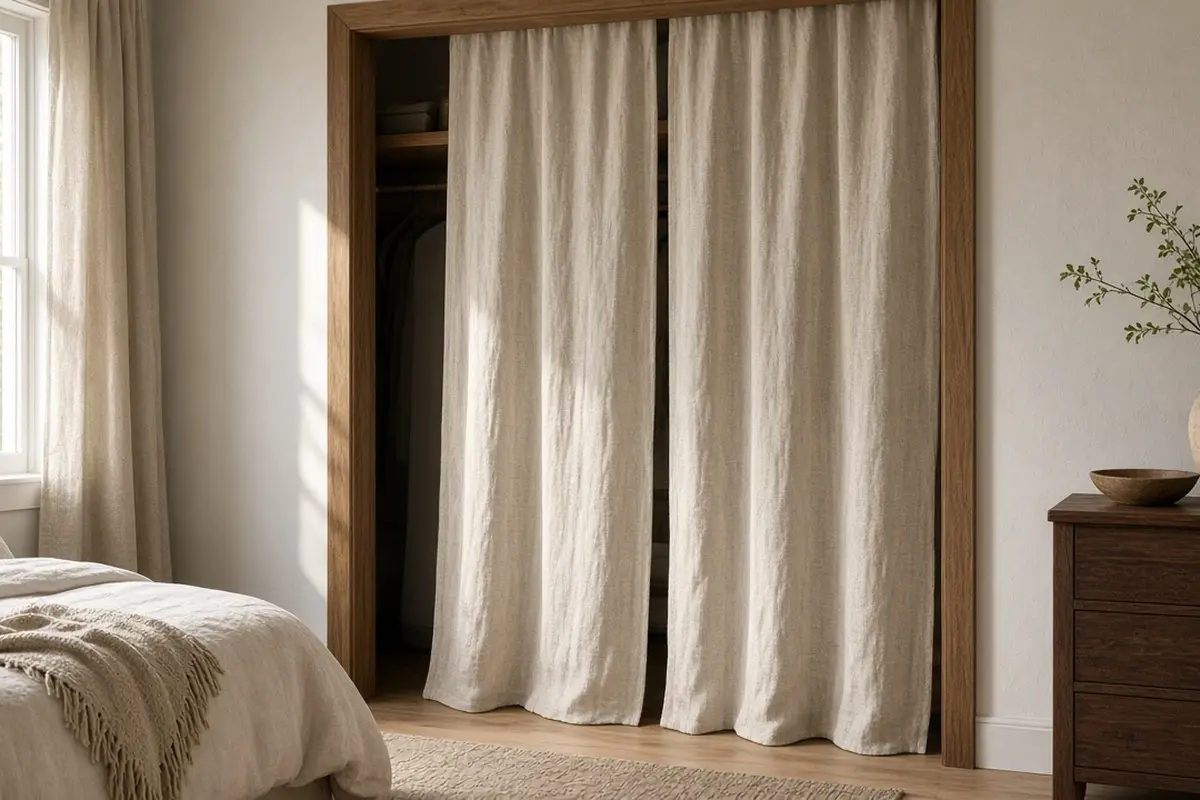
Linen or a linen blend hangs beautifully, filters light, and suits almost every bedroom style. Choose a medium weight so the curtain hides the clothes behind it without looking heavy. White, oatmeal, and soft gray blend into the wall.
Linen wrinkles, which is part of its charm, but if you prefer a crisper look, a cotton or polyester linen-look fabric holds its shape better. Wash linen curtains before hemming if they are not pre-shrunk, as they can lose an inch or two in length. Steaming them once after hanging lets the folds settle evenly.
Get the look
3. A tension rod for renters
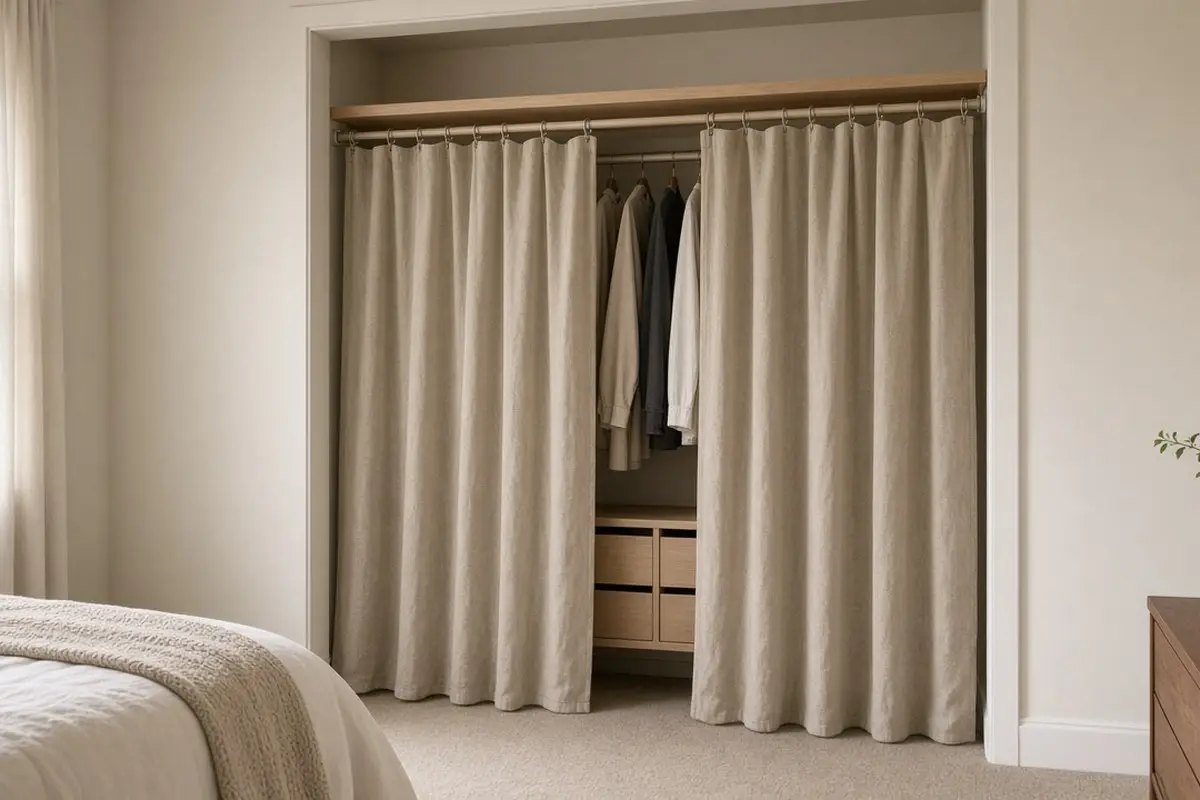
A tension rod fitted inside the closet opening needs no screws and comes out cleanly when you move. Choose a heavy-duty rod rated for the weight of your fabric, and use curtains with a rod pocket or ring clips.
Tension rods work best in openings up to about five feet wide. Beyond that, they can bow under the weight of fabric. For wider closets, use two tension rods with a center support or a lightweight curtain. A small rubber pad at each end helps the rod grip and protects the paint.
Get the look
4. Patterned fabric as a feature
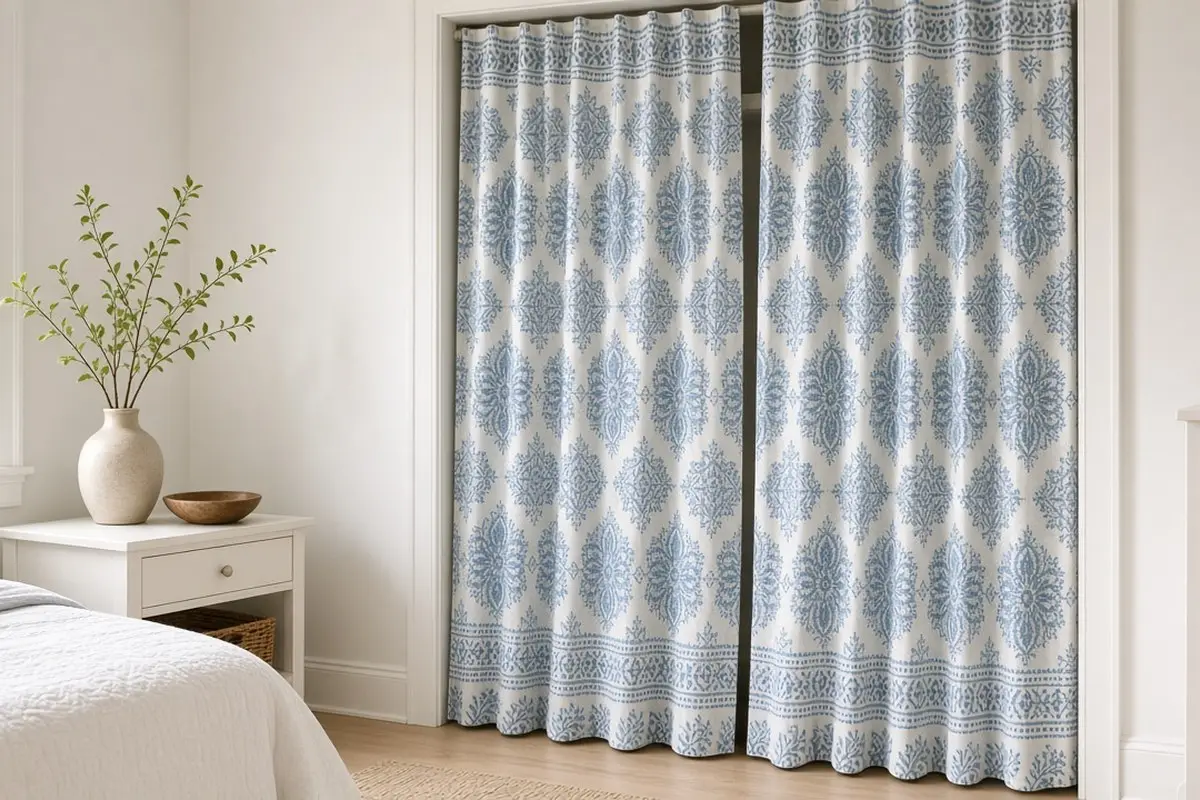
A closet curtain can be the one pattern in a calm room. A small floral, a ticking stripe, or a block print adds personality without committing to wallpaper. Repeat one color from the pattern elsewhere, in a pillow or a throw, to tie it in.
If you love the idea of pattern but worry about committing, choose a removable curtain and swap it seasonally: a lighter cotton print in summer, a heavier wool or velvet in winter. Since a closet curtain is small compared to a whole wall of wallpaper, it is an affordable way to change the feel of a room.
Get the look
5. Matching the window curtains
Using the same fabric for the closet and the windows makes the room feel cohesive and turns the closet into part of the wall rather than a separate feature. Hang both at the same height for a tidy line.
This works particularly well when the closet and window sit on the same wall or on adjacent walls. A single continuous track across both, with curtains in the same fabric, makes the room look like it has one long run of drapery. When the closet curtain is closed, the wall reads as a gentle, uniform backdrop for the bed. Choose a fabric with enough body to hang well in both places, and use the same hardware finish throughout so nothing jars.
6. A blackout lining for kids’ rooms
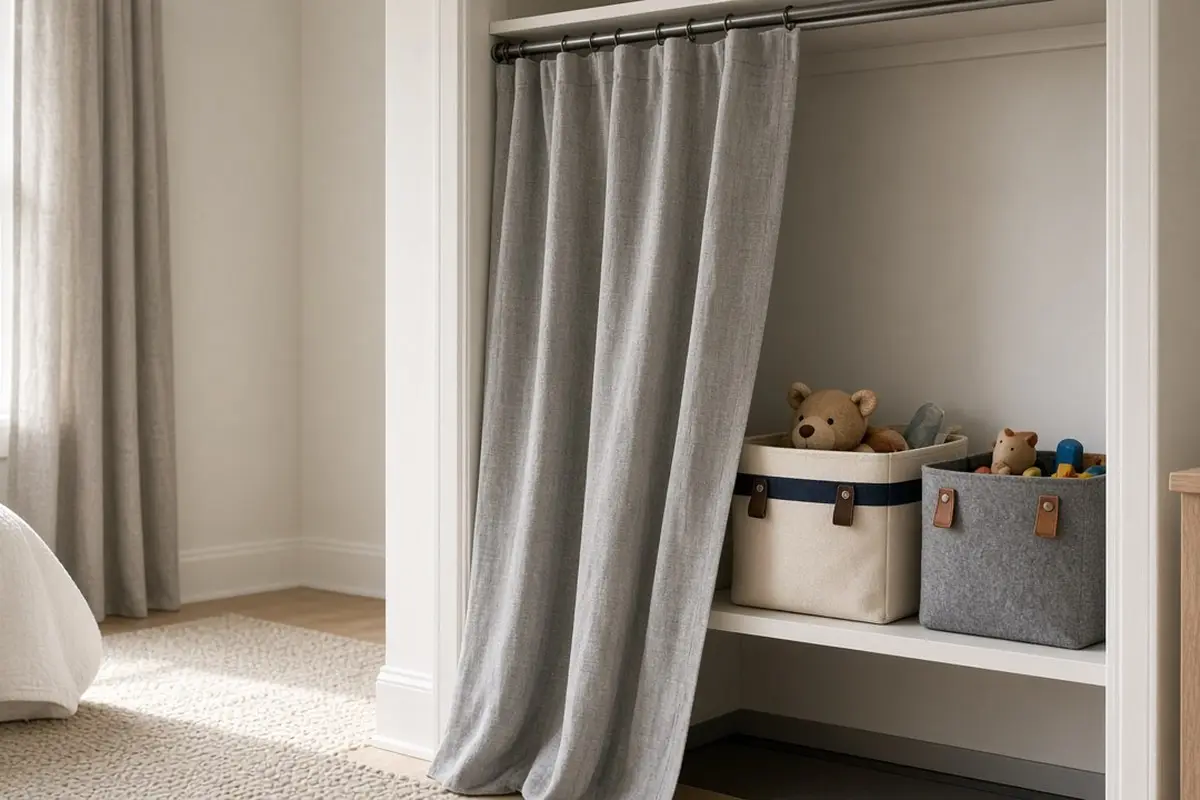
In a child’s room or a nursery, a lined curtain hides toys and clothes and blocks light from a closet with a window. Lining also adds weight so the curtain hangs straighter.
For small children, choose a curtain that is easy to open with a gentle tug, with no cords that could become a hazard. Fabric ring clips or a simple rod pocket on a low rod let kids get to their own toys and clothes. Hang the rod securely, as children will inevitably swing on curtains at some point. A durable, washable fabric is worth it here; sticky hands find curtains quickly.
Get the look
7. A curtain for an open alcove## A note on bifold tracks
If you remove bifold doors, you may find a metal track screwed to the top of the frame and small pivot brackets at the floor. Unscrew both and fill the holes with spackle before painting. Leaving the top track in place can work as a guide for a ceiling curtain, but most people find the frame looks cleaner with it gone. Keep the doors and hardware in storage if you rent, so you can put them back when you leave.
7. A curtain for an open alcove
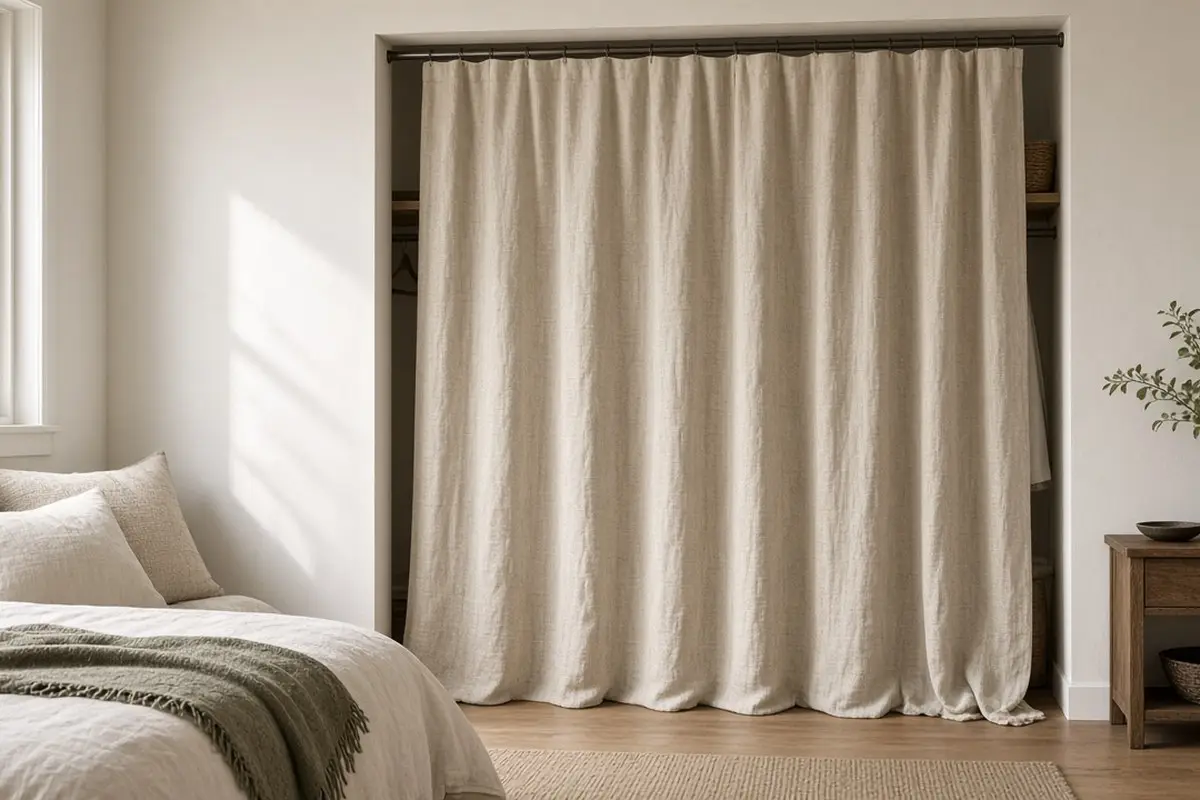
If you do not have a closet at all, a rod and curtain across an alcove creates one. Add a hanging rail and shelves behind, and the curtain closes it off.
This is a good solution in older homes, attic rooms, and studio apartments where built-in storage is scarce. Measure the alcove depth: you need about twenty-four inches for clothes on hangers to fit facing forward, or around fourteen inches if you hang them on a rail parallel to the wall, using a pull-out rod. A small light inside the alcove makes it feel like a proper closet.
Get the look
Hardware details
Choose ring clips, ripplefold, or pinch-pleat hooks rather than rod pockets for a curtain you open daily; they glide more easily. Holdbacks or tiebacks keep the curtain open when you want to see everything. A simple brass hook or a fabric loop on the wall beside the opening is enough.
Finish matters. Brass, black, and nickel hardware each suit different rooms, and matching them to the door handles or lamp bases in the bedroom ties the look together. For ceiling tracks, white or a finish that matches the ceiling disappears entirely, which is often the most elegant choice. Wand pulls attached to the leading ring let you open the curtain without handling the fabric, which keeps light linens cleaner for longer.
Think about cleaning too. Curtains near clothing collect lint and dust. Choose a washable fabric, or plan to vacuum the curtain with a brush attachment every few weeks. Removable hooks or ring clips make taking the panels down for washing quick.
When a door is still better
Curtains are not right for every closet. If the closet holds a noisy washer or a water heater, a solid door muffles sound better. In homes with cats who like to climb fabric, a door may save frustration. And if you need to lock a closet, a curtain obviously will not do. For most bedroom closets, though, a well-hung curtain is lighter, quieter, and easier to live with than the door it replaces.
Common questions
Can you use a curtain instead of a closet door? Yes; a curtain opens the full closet width and needs no swing space.
How high should a closet curtain hang? As high as possible, ideally at the ceiling, with the hem just above the floor.
What fabric is best for a closet curtain? A medium-weight linen, cotton, or linen blend hangs well and hides the contents; add a lining for more opacity.
How wide should a closet curtain be? Total fabric width should be one and a half to two times the rod length, with the rod extending at least six inches past each side of the opening so the curtain can stack clear.
Do closet curtains work in a small bedroom? Yes, and often better than doors, since they need no swing space and soften the room.
For more, see bedroom door curtain ideas and reach-in closet layouts.